

The 2026 Industry Challenges
Five enterprise challenges across aerospace, healthcare, energy, finance, and mobility. Choose your problem, submit your proposal, and compete for $40,000.

Quantum solvers: enhancing predictive aerodynamic modeling
Accurately predicting aerodynamic flows requires solving Partial Differential Equations using state-of-the-art HPC. Current methods face severe scalability limits, with continued reliance on expensive wind tunnel testing at extreme acceleration and Mach conditions. Airbus is seeking more efficient PDE solvers so novel product solutions can meet demanding quality and environmental requirements.
View
Unlocking undruggable targets: quantum simulation of allosteric signal propagation
Over 85% of disease-causing proteins are considered undruggable — they lack the deep active sites traditional small-molecule drugs need. The only viable strategy is allostery: identifying hidden regulatory pockets that shut down the active site from a distance. Classical detection requires months of MD simulations, and current approximations are too linear to capture the non-linear dynamics of biological signal propagation.
View
Quantum-enabled grid expansion planning for distribution energy networks
The energy transition is driving rapid growth in renewables while demanding greater grid resilience. Expanding medium and low voltage networks is a large combinatorial optimization problem — build-or-no-build decisions tightly coupled to network physics across many operating scenarios. Classical solvers like Gurobi and CPLEX struggle to find provably optimal solutions for hard instances at scale, forcing operators toward more conservative planning.
View
Quantum-enhanced credit card fraud detection for digital payment ecosystems
Credit card fraud costs $34B annually, with $404B projected over the next decade. Classical ML provides a strong foundation, but higher transaction volumes, richer feature sets, and extreme class imbalance (0.172% fraud rate in benchmark datasets) keep raising the bar. Best-in-class classical models on the IEEE-CIS competition achieved an AUC-ROC of 0.9459, leaving meaningful headroom for approaches that capture subtler cross-feature patterns.
View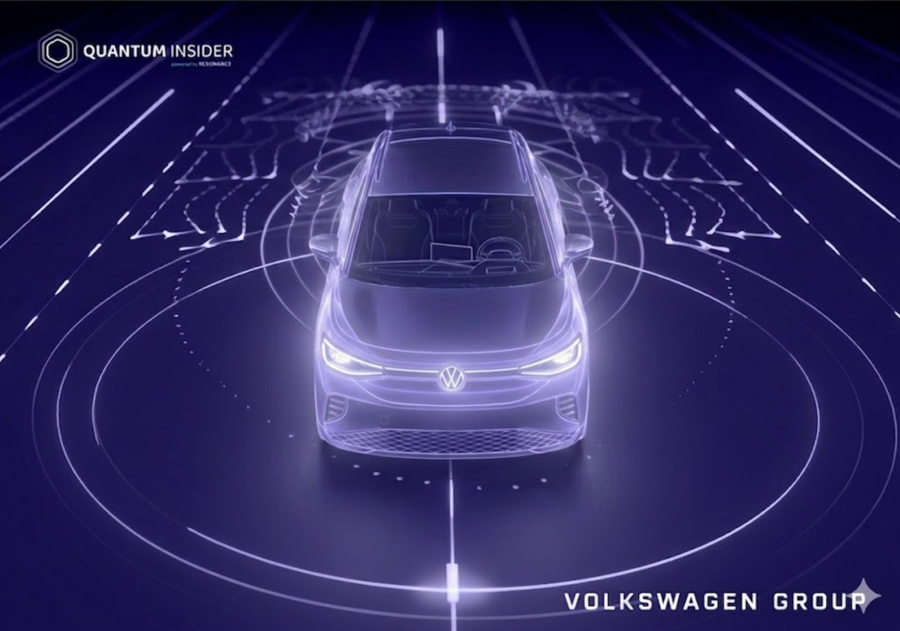
Quantum-enhanced Vision-Language-Action models in autonomous driving and robotics
Vision-Language-Action Models (VLAMs) are becoming the backbone of autonomous systems, processing multimodal sensor data to produce planning and control outputs. Models at 7B–10B parameter scale are prohibitively expensive to train and nearly impossible to deploy on embedded vehicle hardware without significant accuracy loss. OEMs, suppliers, and robotics manufacturers need VLAM-grade perception to run on in-vehicle compute units — not cloud GPU clusters.
View